Planners · 5 min read · 20 June 2026
Classroom Organisation: How Teachers Use Digital Planners
Lesson layouts, attendance pages, newsletters, and weekly reset habits — a practical system for educators who need calm more than clutter.
Teaching days rarely go exactly as written — and that is fine. A classroom planner is not about controlling every minute. It is about giving your future self a clear map when energy is low and decisions are many. The best systems are humble enough to survive a fire drill, a last-minute assembly, and a week of parent emails.
Digital and printable teacher planners help because you can reuse structures term after term while updating only what changes: class lists, units, and parent communication. That reuse is where the real time savings live. You are not reinventing organisation every September; you are refining a toolkit that already knows how your classroom works.
Start the term by deciding which pages you will actually touch daily. Everything else can stay in a digital master folder until needed. A thinner daily stack beats a beautiful binder you never open during the rush between periods.
Build a weekly teaching spine
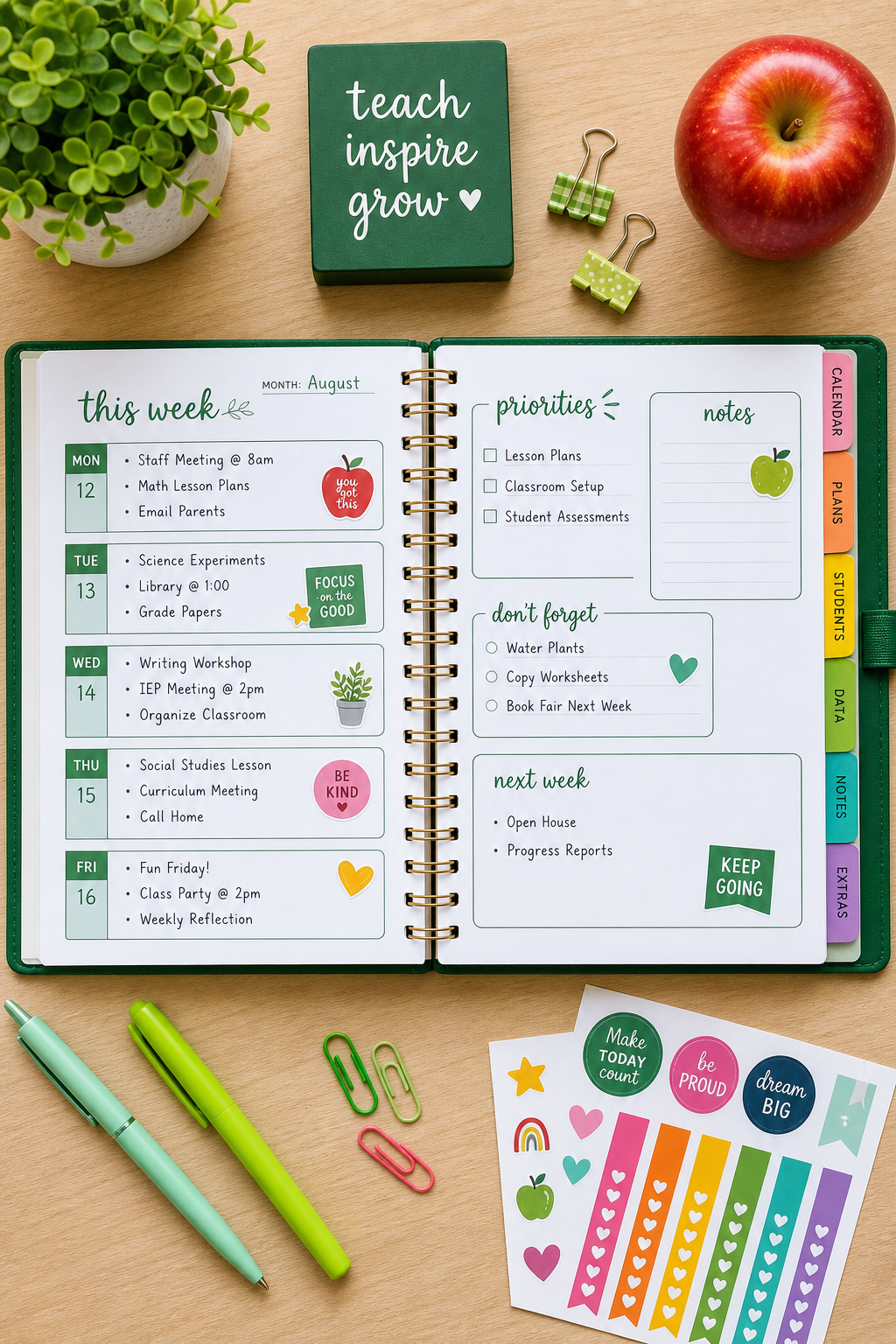
Use weekly lesson pages for objectives, materials, and differentiation notes. Keep the format identical each week so filling it becomes muscle memory. When a lesson runs long or a fire drill appears, you still know what mattered most that day. Write the non-negotiable learning goal first, then the nice-to-have extension activities underneath.
Place attendance and quick grade trackers near your weekly spread. Tools that live in three different apps get ignored. Tools that sit on the same clipboard or tablet section get used. If your school requires digital gradebooks, use the paper tracker only for formative checks and transfer scores in one short end-of-week block.
Reduce morning friction
- Keep a seating chart printable with the week’s notes.
- Use classroom checklists for opening and closing routines.
- Park volunteer tasks on a visible list parents can join.
- Store emergency sub plans in the same planner section.
- Prep tomorrow’s materials before you leave each afternoon.
- Keep a running list of students who need a quiet check-in.
These pages look ordinary until a chaotic morning arrives. Then they become kindness to yourself. Opening routines especially benefit from checklists: lights, attendance, morning work, announcements. Closing routines protect the next day — wiped boards, stacked books, notes for the substitute you hope you will not need.
Parent communication without inbox overwhelm
Monthly classroom newsletters prevent a dozen one-off messages. Update birthdays, reading themes, trip reminders, and volunteer asks in an editable template. Send PDF by email or print a stack for bags. Families learn where to look; you spend less time rewriting the same information in slightly different wording every week.
For sensitive conversations, the planner can still help. Keep a simple contact log page with date, topic, and follow-up. You do not need a novel — just enough record to stay professional and fair when memory is tired at the end of term.
Organisation is not perfection. It is a head start for the next tired Monday.
A weekly reset that protects your energy
Choose one fixed reset slot — Friday after dismissal or Sunday evening. Clear papers, update next week’s spine, and restock any printed forms you used. Ten focused minutes here prevent Monday from starting in a scavenger hunt for last week’s handouts.
Eden Delight’s teacher planner and classroom organiser pages are designed for print-and-reuse workflows. Print what you write on daily; keep masters digitally for next year. Protect your energy for the students in front of you — that is the real point of any planner system, and the only metric that matters when June finally arrives.
At the end of each term, archive what worked. Save filled weekly spines as reference for next year’s pacing, and note which newsletter sections families actually responded to. Small reflections compound into a classroom system that feels lighter every September because you are no longer starting from a blank binder and a tired memory.
Organisation for teachers is ultimately about presence. When materials, plans, and parent notes are easy to find, you have more attention left for the child who needs an extra explanation or a quiet word of encouragement. That is the outcome worth designing for — not a colour-coded aesthetic that collapses under real school-day pressure. Build the system once, reuse it often, and let it serve the learning.